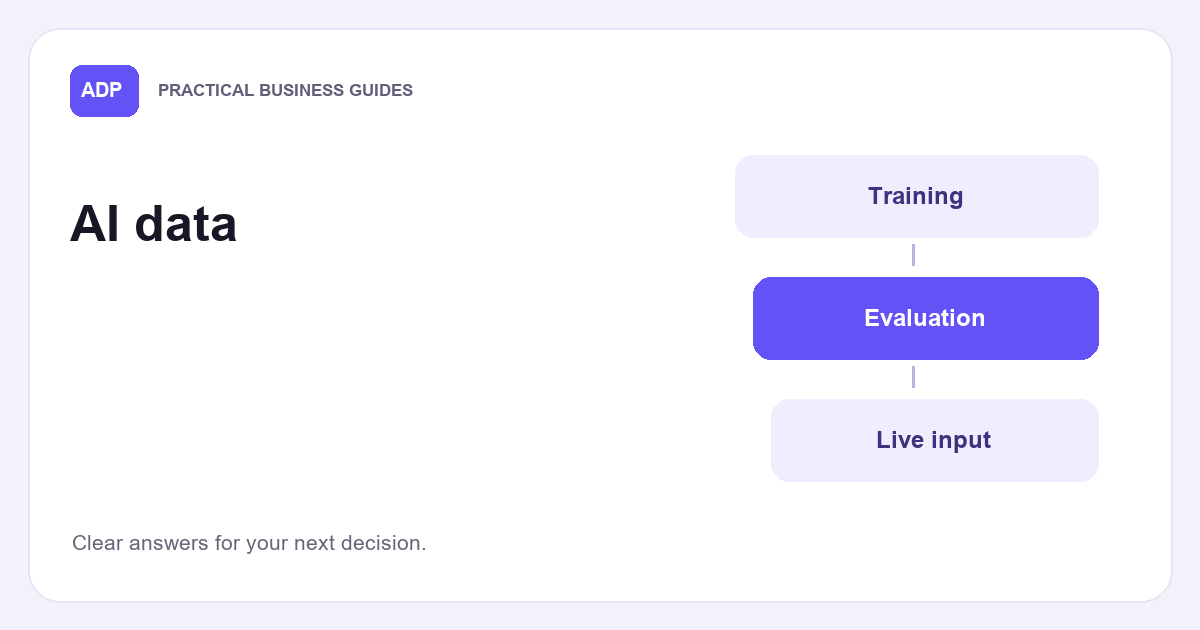
AI data is information used by an AI system, but its job changes with the stage of use. Some records help a model learn, some are reserved to check its performance and others arrive with a live request. Those categories can include personal information, so calling something a dataset doesn't tell you what you may do with it.
ADP (Accord Data Partners) provides a paid introduction course and a portal for people exploring business introductions. It is independent of buyers and never receives company datasets. If you're assessing your records, the useful first question is what someone proposes to do with them, not whether they look like a typical training file.
What does data mean in an AI system?
A record's role depends on the task, not its filename. AI data might be an example used to develop a model, a separate example used to check it or information supplied when someone asks the finished system a question. Even a familiar spreadsheet could serve different roles in different projects, under different permissions.
Hypothetical worked example: a repair firm has product codes, dated service notes and a table of completed jobs. A developer might use older entries to learn how jobs are classified, reserve other entries to check the classifications and look up a current product code during a live request. These are possible uses, not a proposed deal.
Don't confuse the material supplied to a system with what it produces. A model output could be a suggested job category or a draft reply. It doesn't automatically become new training material. When someone asks for AI data, ask which records they mean and whether they want to develop, assess or operate a system.
What is training data used for?
During training, a system learns patterns from training examples rather than answering a customer's immediate request. AI data used here might show which description matches a job type or which fields tend to occur together. The task determines what an example needs to contain. A pile of records isn't useful simply because it's large.
A labelled example includes an intended answer, such as a service note paired with the correct job category. An unlabelled example has no such supplied answer and may be useful for a different learning approach. Check who assigned any labels and what they mean. An internal shorthand may not be a reliable description of the underlying job.
Dataset quality starts with basic questions: are dates consistent, are duplicate jobs counted twice and do missing fields mean the same thing across systems? Those questions take real work to answer. For a closer look at the distinct process of preparing records for a licence, see the training data licensing guide.
Why are evaluation examples kept separate?
An evaluation set is used to see how a model performs on examples it didn't learn from directly. That makes the distinction between training and checking central to understanding AI data. Google's machine learning glossary distinguishes these dataset roles. The useful question is whether the check resembles the work the system is expected to handle.
Validation data may help a developer compare versions or adjust a model during development. A held-out test is generally reserved for a later assessment, after those choices have been made. The precise arrangement varies by project, but repeatedly consulting the final check while making adjustments makes its result less independent.
Data leakage can make a check look better than it deserves. Imagine nearly identical entries for the same repair appearing in both training and checking groups, or a field revealing the answer assigned afterwards. For dated business records, separating by time or by customer may give a more meaningful check than splitting individual rows at random.
What happens when someone uses a model?
A live request supplies an inference input, such as a question, an attached document or a product code to look up. This is another way information becomes AI data, even when it was never part of model development. The system uses that input to generate a response for the task at hand.
If you ask a tool to draft a supplier email from delivery notes, those notes can affect the reply. That alone doesn't establish whether the provider stores them, reviews them or uses them for later training. Check the particular tool's terms and settings before entering sensitive material. Different services make different arrangements.
Some systems also retrieve information from a current catalogue or knowledge base while answering. That can change the answer without changing the underlying model. If a proposed use involves your records, establish whether they would be retrieved for live answers, used to develop the model or both. Each description implies a different practical job.
Which formats can records take?
AI data isn't limited to spreadsheets. Text records might include service notes, product descriptions or carefully selected extracts from documents. A readable page can still be difficult to work with if dates sit inside free text or the same abbreviation means different things to different teams. Format tells you little about consistency.
Image files can contain useful details that never made it into a database, such as markings on a component or handwriting on a form. They may also need sorting, legibility checks and a way to connect each image to the right job. Converting an image to text doesn't necessarily preserve everything that matters.
Tabular records give fields and rows an apparent order, but you still need to know what one row represents. Is it a job, an invoice line or a later correction? Units, blank values and changing column definitions affect interpretation. A tidy export from one system may not match an export from its replacement.
Why does context change the meaning?
Source context tells you what a record was created to describe. A status marked “cancelled” might mean a customer withdrew a booking, an engineer couldn't attend or an office worker replaced a duplicate entry. Strip away that distinction and AI data that looks consistent may teach or test the wrong interpretation.
Data provenance is the record of where information came from and what happened to it. For a business owner, that might mean identifying the source system, the period covered and whether staff entered values or software calculated them. You don't need a grand technical inventory to spot that two apparently matching columns have different origins.
Time matters too. A code used before a policy change may describe a different process from the same code used afterwards. If someone proposes combining years of records, ask which definitions changed and when. A short explanation of those changes can be more valuable for interpreting the material than another unexamined export.
What makes business information usable?
Start with the proposed task and collection scope. Which years, locations, record types and fields would actually help answer it? AI data drawn from every folder can introduce irrelevant material and unnecessary review. A narrow description lets you estimate the work involved and identify records that should stay outside the discussion.
Next, check a representative sample for missing values, inconsistent labels and files that won't open in the expected format. Google's AutoML preparation guidance explains that tools don't remove the need to prepare and check data. The practical question is who would do that work and how its cost would be assessed.
Usability isn't the same as permission. Records can be clean and still include confidential material or details about identifiable people. Pseudonymised data can remain personal data. Before discussing a specific use, identify which categories need separate review rather than assuming that removing names or producing a neat extract settles the matter.
How does licensing fit into this picture?
AI data licensing concerns permission for a defined use, not a general claim that records are valuable. Usage rights might need to distinguish development, evaluation and live operation, along with who can use the material and under what limits. ADP cannot approve eligibility or offer a licence. The business and buyer agree their own terms.
If you want to explore whether you could sell your company data, keep the decisions separate. A business owner’s consent to an introduction does not itself establish a lawful basis for processing personal data in the records. It also doesn't resolve confidentiality duties, copyright ownership or authority under existing contracts. A licence between the parties does not, by itself, settle privacy obligations.
Your next useful step is to describe the record types you control and the use you would be willing to discuss, without sending records to ADP. The ADP information for businesses explains the owner route. An introduction is a starting point for discussion, not an approval or a promise that a licence or payment will follow.
Frequently asked questions
Is everything entered into an AI tool used to train it?
No. A live input helps the system respond to that request, but storage and later use depend on the particular tool's terms and settings. Check those before entering sensitive business information.
Does removing names make business records anonymous?
Not necessarily. People may still be identifiable from other details, and pseudonymised data can remain personal data. Assess the material and its proposed use separately.