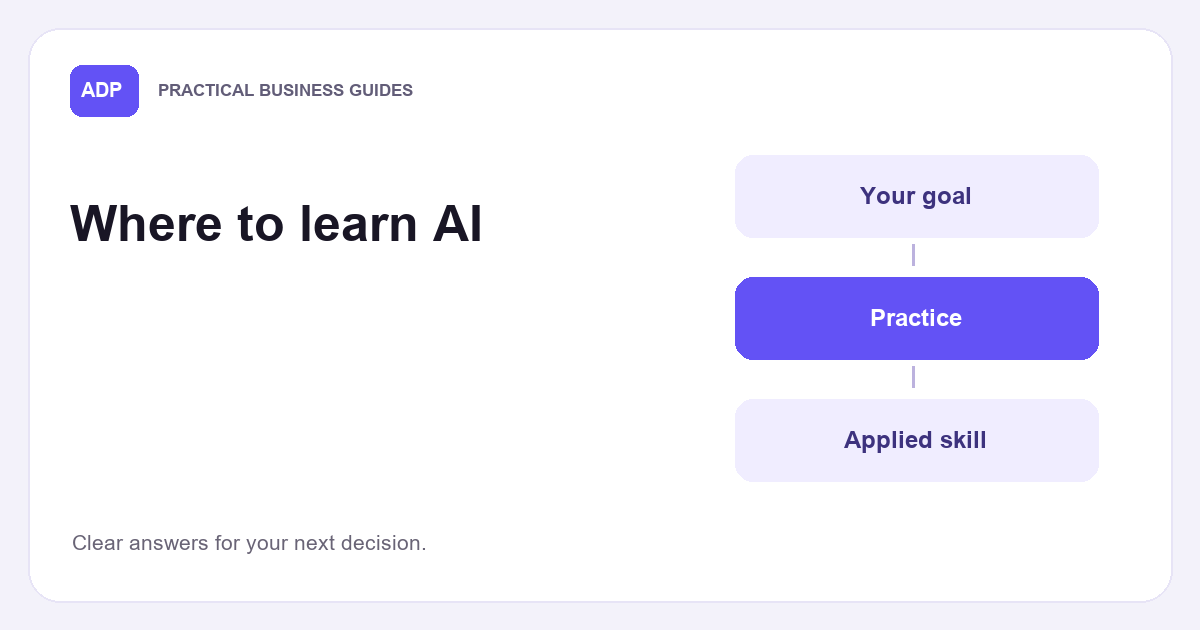
The best place to learn AI depends on what you need to do. If your aim is to make clearer decisions at work, you don't need to begin with mathematical concepts or coding. Choose a route that matches the output you want, then test it on a small task before committing to a longer course.
Some AI courses explain concepts, some teach you to use tools and others expect you to write software. Set a learning goal before comparing them. ADP, or Accord Data Partners, offers a separate paid introduction course and portal for people exploring data licensing. It isn't a route into building models.
Choose what you want to do first
To learn AI for everyday work, start with the decisions you make and the documents you produce. If you want to build software, you'll need a more technical route. If you're interested in data licensing, you'll need to understand ownership and introductions. Those are different jobs, so one course is unlikely to serve all three equally well.
Compare AI courses by their exercises, not just their titles. Look at the course prerequisites and the work you'll be asked to submit or practise. A course built around writing code won't be the quickest answer if you only need to assess draft text. Equally, lessons on prompting won't teach you to test a model you've built.
If you want to learn AI because you're exploring an income idea, identify the work before thinking about payment. Would you create software, help a firm use an approved tool or introduce a business interested in discussing its records? Each route calls for different skills, permissions and costs. Pick one to investigate rather than treating them as interchangeable.
Build a plain-English foundation
The Elements of AI project's An Introduction to AI is intended for people without programming or complicated maths. It covers what AI can and can't do, which makes it a sensible starting point if you need to discuss tools with colleagues rather than build them. The project's separate Building AI course goes further and recommends basic Python skills.
When you learn AI, distinguish a system trained on examples from software that follows fixed rules. Machine learning basics include what a system is trying to predict, what information it sees and how you check whether it works on unfamiliar material. That gives you useful questions to ask even when someone else chooses the technology.
Good introductory AI courses also help you separate a convincing answer from a dependable one. Try explaining, in your own words, what information a tool received and what you would need to verify independently. If you can't describe that gap yet, stay with foundational material before relying on the tool for a business decision.
Practise a small workplace task
To learn AI through use, choose one workplace task with a result you can inspect. Drafting questions for a meeting is easier to assess than asking a tool to run a whole process. Use invented or approved material, give it a clear brief and compare its output with what you would have written yourself.
Hypothetical worked example: an adviser needs a neutral checklist for a first conversation about stock records. They create a synthetic example with invented product names, ask a tool to group the questions and compare its answer with the brief. AI courses can teach that workflow, but the adviser still has to decide which questions are suitable.
If you learn AI through generated answers, practise source checking alongside drafting. Ask where a factual claim came from, open the cited page and check that it actually supports the point. For an internal summary, compare the answer with the material you supplied. A polished sentence isn't evidence that a date, rule or number is right.
Understand what a technical course expects
Technical AI courses need a different kind of practice. Google's Machine Learning Crash Course includes material on working with categorical data, datasets, generalisation, overfitting and large language models. Those topics matter if you want to understand how a model is trained and tested, rather than just use an existing tool.
You can learn AI without writing software, but implementing a model calls for other preparation. Check your Python knowledge by reading a short script that loads data and calculates a result. If that feels unfamiliar, practise those steps first. Otherwise, time spent debugging basic code may crowd out the lesson you wanted about models.
The Microsoft Learn path titled Get started with AI applications and agents on Azure starts with an introduction to AI workloads, then moves into building applications with Microsoft Foundry tools. It expects a basic understanding of computing concepts and Python. That makes it a closer fit for aspiring developers than for someone seeking office writing practice.
Learn how datasets affect results
To learn AI data work, ask what the training examples represent. Suppose a stock classification exercise contains clear records from one product range but few from another. A model might appear capable on familiar items while making poor decisions elsewhere. The useful question isn't just how much data exists, but which situations it covers.
For model evaluation, decide what a wrong answer would cost before choosing what to measure. In an exercise that flags missing stock information, overlooking a missing field may matter more than asking someone to check a complete record. Compare results on material kept out of training, and inspect the mistakes rather than relying on one headline score.
If you learn AI through dataset exercises, build in human review for ambiguous labels. Two people may classify the same incomplete record differently, so write down the rule they used and resolve disagreements before treating either label as certain. Practise on invented or appropriately permitted material, not company records copied into an outside course.
Study licensing introductions separately
AI courses about models aren't the same as learning business introductions. An introducer identifies a relevant data owner, explains a proposed contact and seeks the business's consent to that introduction. ADP is independent of buyers and never receives company datasets. Consent to make contact does not, by itself, establish a lawful basis for processing personal data.
You can learn AI data licensing as a separate commercial subject: who controls the records, what rights might be available and what a buyer would need to discuss with the owner. The sell AI data page explains ADP's paid introduction course and portal. It isn't a place to upload records or a qualification in model engineering.
A paid course can't confer rights to use business records. Permission to make an introduction is separate from confidentiality duties, copyright, contract authority and privacy requirements. Pseudonymised records can still be personal data, and a licence doesn't settle those obligations. Study these as questions for the relevant parties to resolve, not boxes an introducer can tick for them.
Judge a course before paying
When comparing AI courses, inspect a sample lesson and the description of one exercise. Can you see what you'll make, what prior knowledge it assumes and how you'll tell whether you did it well? A list of topics is less helpful than a task that matches the work you intend to do.
To learn AI efficiently, ask whether a practical exercise resembles your intended job. If you need to review generated summaries, an exercise that includes checking the original document is relevant. If you want to build software, look for opportunities to run code and inspect errors. Don't pay for an outcome the lessons don't actually teach.
Check the full cost of participation, including any software or account needed for exercises, and read the current terms before buying. Work out when you could practise and what you would stop doing if the course isn't a fit. Finishing lessons is useful, but it's not the same as being ready for paid work.
Build evidence that you can apply the lesson
Keep a small record of what you tried. Save the task brief, your first attempt, the revised result and a note explaining what changed. For a drafting task, mark unsupported claims. For a coding task, record which inputs failed. This gives you something more useful to revisit than a list of completed videos.
You can learn AI without turning every exercise into a public portfolio piece. For private practice, use an invented scenario and explain its limits: which facts you checked, which judgement remained yours and what you'd change next time. That account shows whether you can apply the lesson without presenting fictional work as a customer result.
If making introductions interests you more than building models, read ADP's guide to AI data brokering to understand the work before deciding whether it fits your skills. ADP cannot approve a business's eligibility, grant a licence or guarantee earnings. Any licence is agreed between the business and buyer.
Frequently asked questions
Do I need to code to start learning about AI?
No. You can begin with concepts and carefully checked tool exercises. Coding becomes relevant if your goal is to build or test models and applications.
Is ADP's course a machine learning course?
No. It covers business introductions connected with potential data licensing, not model engineering. ADP does not receive company datasets or grant licences.