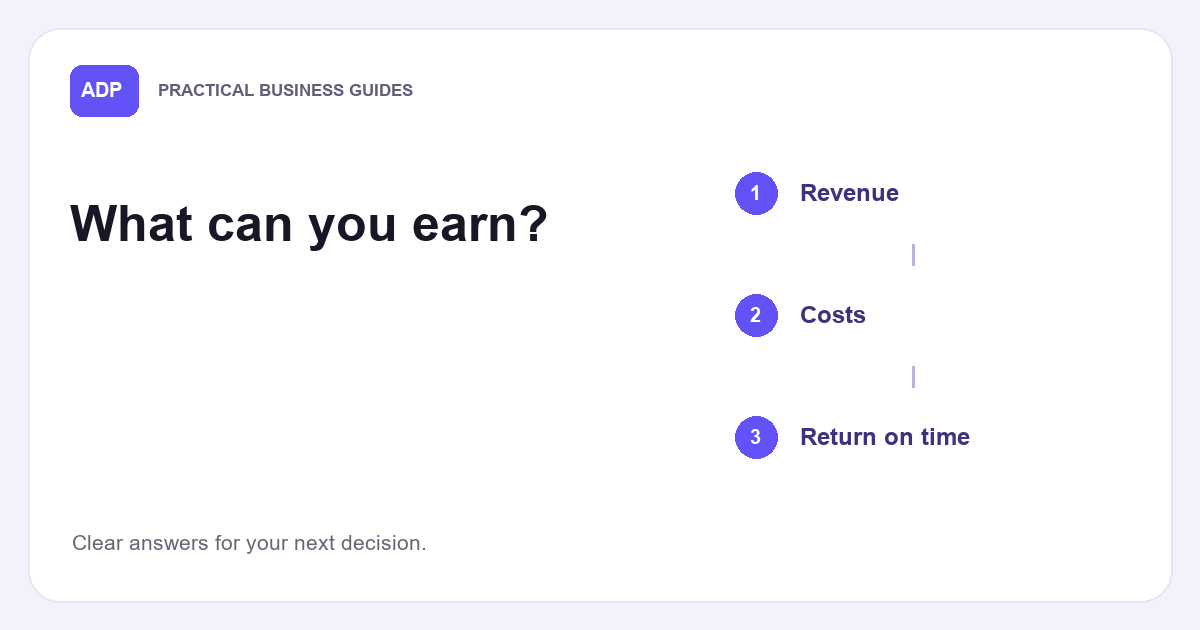
There’s no credible single figure for AI earnings. What you can charge matters, but so do the hours and costs needed to get paid. Start by finding your break-even point, then ask what remains for your time. That gives you a decision you can test, rather than an income claim you can’t verify.
A high price can make gross revenue look promising while leaving little behind. A hypothetical example later in this guide shows how to calculate a return from a small service, including work you never put on an invoice. It isn’t a rate to expect. Your own figures will depend on the job and how you find customers.
Why is there no reliable universal earnings figure?
AI earnings can come from client services, products you make once and sell repeatedly, or introductions that might lead to a payment. Those are different jobs with different routes to getting paid. ADP’s sell AI data page explains its paid introduction course and portal. It isn’t a course in building AI models or a place to send company records.
Two people charging the same price can finish with different net profit. One may already have clients, while the other must spend weeks finding a first order. One may have permission to reuse their material, while the other must create everything from scratch. Compare the work behind a sale before comparing prices.
The type of customer matters too. A service usually has delivery hours attached to each order. A digital product needs creation, support and a way for people to discover it. An introduction depends on someone else deciding to proceed. Those differences make a universal monthly figure more misleading than useful.
Separate price from profit
For AI earnings, write down the amount the customer agrees to pay, then subtract the costs caused by that work. Keep tax separate from this first calculation. An invoice also isn’t cash in your account: note whether it’s been issued, paid or disputed. Otherwise a busy month on paper can hide a cash shortage.
Put customer acquisition on its own line. It might mean time spent writing proposals, answering enquiries or showing a sample of your work. If you pay for advertising, record that spending as well. Dividing those costs across completed orders shows whether the price covers the effort needed to win them.
A useful AI earnings comparison uses the same period for income and costs. Don’t put one month’s sales against a full year’s tool fees, or ignore the setup work that made those sales possible. Keep a simple monthly record and a separate total for work done before your first sale.
Count the time outside delivery
A software subscription may be easy to spot on a bank statement. The harder costs are often the hours spent learning a tool, checking its terms and deciding whether its output is suitable for a client. Record the fee and the time separately. Paying for software doesn’t make every task faster.
Build quality review into the job, not into whatever time happens to be left. If you draft customer-facing copy, you still need to check facts, tone, permissions and whether it answers the brief. A client is paying for usable work, not a raw output. That checking time belongs in your estimate before you quote.
Track AI earnings against all hours spent on the offer: enquiries that go nowhere, revisions, admin and chasing payment as well as completed work. A short weekly log is enough to reveal where time goes. If selling takes longer than delivering, changing the offer or sales method may help more than buying another tool.
Work through a small service example
Hypothetical worked example: suppose you charge £180 to draft and check a set of FAQs for a client. You complete two orders and invoice £360. For planning, allow £20 for a tool, £10 for payment charges and £30 towards possible refund costs. Every figure here is invented to demonstrate arithmetic, not a typical price or result.
Subtracting those £60 of planned costs leaves £300 before tax, provided both invoices are paid and the allowance proves sufficient. Suppose the jobs take four hours in total, finding customers takes five and admin takes one. That’s ten hours, giving £30 per hour in this scenario. It isn’t an AI earnings estimate for anyone else.
Now suppose revisions add three hours without changing the price. Thirteen hours for the same planned £300 brings the hourly figure to about £23.08 before tax. Note that unpaid time against the order that caused it. The next decision might be a clearer revision limit, a higher quote or a narrower service.
Test the economics of a digital product
A template or guide can be sold more than once, but repeat demand isn’t automatic. Before making one, identify who has the problem, where they would find the product and what support they might need afterwards. Count the hours spent creating instructions, testing downloads and answering questions, not just the minutes needed to generate a draft.
For product-based AI earnings, separate the one-off creation work from costs attached to each sale. A low-priced download might cover its payment fee easily but take many sales to repay your setup hours. If customers need regular updates, that work continues after launch. Check that you have the rights to include everything you sell.
Choose a sales target and calculate the effective hourly return at that target. Then try a smaller number of sales and include the time spent promoting the product. If the result only works when many strangers buy immediately, you’ve found an assumption to test before investing more effort, not a forecast.
Understand contingent referral income
An introducer’s job is different from delivering a service or selling a download. For AI earnings through introductions, you need to understand what makes an introduction appropriate and when, if ever, payment becomes due. ADP is independent of buyers, provides a paid introduction course and a portal, and never receives company datasets. Its referral rewards guide explains the model without promising payment.
Don’t treat every conversation as a payable lead. Write down your conversion assumption in plain terms: how many suitable businesses would need to agree to an introduction, and what further events would need to happen? If you can’t establish those terms, leave the prospective payment out of your working budget. Interest alone isn’t a completed deal.
Check payment timing as carefully as the possible amount. A fee contingent on later decisions may arrive well after the hours you spent making an introduction, or not at all. The business and buyer agree their own licence. ADP can’t approve eligibility, offer that licence or guarantee earnings, so don’t count a possible outcome as money already earned.
Check what the downside would cost
Set a limit on what you’re prepared to spend before the idea has paid you anything. For AI earnings from a service, that might mean keeping tool spending low until you’ve sold the work. For a product, it might mean testing a small version first. For introductions, allow for conversations that don’t lead to payment.
Read any referral condition before spending time on an introduction. Get the business’s permission to make that introduction, but don’t mistake its agreement for permission to share records. A business’s consent to being introduced is separate from the lawful basis for processing personal data, confidentiality duties, copyright and authority under its contracts.
AI earnings never make an unsuitable data transfer worthwhile. Pseudonymised records can still be personal data, and a licence doesn’t itself settle privacy obligations. The ICO’s guidance on data sharing agreements describes agreements as a way to document purposes and responsibilities, not immunity from data protection law. Check what may lawfully be shared before discussing any dataset.
Set a useful first target
Pick a target you can control before aiming for an income figure. For a service, that could be costing and testing one clearly scoped offer. For a product, it could be checking whether prospective customers understand it. For introductions, it could be learning the process and permission requirements. Buyer acceptance isn’t something you can set as your personal target.
Give the test a spending limit and a review date. List each fixed cost you’ll pay even if nothing sells, then decide how many orders would be needed to cover it. Keep the value of your time visible alongside that calculation. Reaching zero cash loss may still leave you doing too much work for too little return.
Finally, record each variable cost that rises with an order, including processing fees or extra support. Compare your actual hours and payments with the assumptions you made, then decide whether to continue, change the offer or stop. If introductions are the route you want to assess, ADP’s introduction model guide is a low-pressure next step.
Frequently asked questions
How many sales would a digital product need to cover its costs?
Add its creation and other upfront costs, then divide by the amount left from each sale after sale-related charges. Round up to a whole sale. Count your creation hours separately if you also want to know whether the return is worth your time.
Does buying ADP’s course guarantee introduction income?
No. The course provides information about introductions, not buyer approval, a licence or guaranteed payment. Any potential income depends on the relevant terms and decisions beyond buying the course.