Potentially. For a buyer interested in workflow evidence, examine the sequence of work and outcomes. A raw CRM export can also contain contacts and notes that need separate review. CRM data licensing starts with an inventory of what you can explain and have authority to make available. ADP is an independent introducer, not a buyer, and never receives company datasets. Keep any controlled sample for a later, separately authorised buyer discussion.
A contact list tells someone whom you dealt with. Workflow records may show what happened next, what your team did and how an issue ended. Buyer requirements would need to be discussed for a specific proposed use, so don't assume that a large database is useful simply because it contains years of names and transactions.
What is actually in your CRM?
Start by listing the record types, not exporting everything. You might have account details, tasks, call logs, deal changes and service outcomes in separate tables. The owner guide on sell your company data covers the broader route. For CRM data licensing, identify which records describe work your business performed and which merely identify people.
Look at the activity history for a few typical records inside your own system. Are calls logged when they happen, or added weeks later? Does a completed task mean someone acted, or that an automated reminder closed? Those differences determine whether an exported event is evidence of a process or just evidence that someone clicked a button.
Check how a sales stage is assigned and whether its meaning changed over time. A move to “proposal” might once have required a sent document but now be triggered by a meeting booking. Write down both definitions and their dates. Without that context, a sequence of apparently consistent status changes can describe two different workflows.
How does a workflow differ from a contact list?
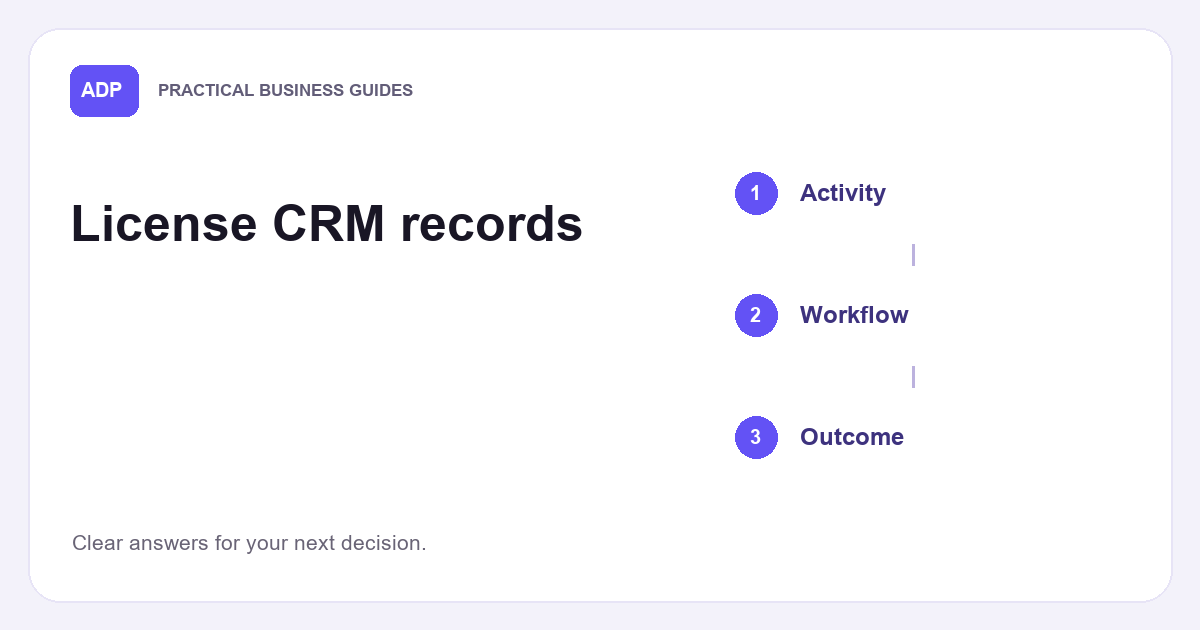
CRM data licensing concerns the link between an event, a decision and what followed. A useful workflow might show that an enquiry was triaged, assigned, revisited and closed, with enough context to distinguish each step. Remove the link between those steps and you have isolated labels, not a reliable account of how your team worked.
Hypothetical worked example: a service team records an enquiry, assigns it to a specialist, makes a follow-up call and marks it resolved. The case outcome only makes sense alongside the earlier steps and the team's definition of “resolved”. If that label also covers customers who stopped replying, the owner must explain the difference rather than treating every closure as success.
An SOP says what staff are meant to do. A support ticket usually centres on one reported problem. CRM data licensing may instead involve linked records across an account and several interactions, showing what staff actually logged over time. Those are different structures. Decide which one you can describe accurately before considering any licensing conversation.
Which fields explain an outcome?
Make a field dictionary for the proposed workflow. For each field, record what it means, who or what fills it in, whether it is optional and whether older records used a different definition. Start with event type, status, assignment and outcome. Leave names and free-text content out of this first description unless they are necessary to explain the structure.
Test the timestamp sequence before drawing conclusions from it. A “created” date may reflect an import, while an “occurred” date reflects the original event. Time zones, bulk updates and backdated entries can reverse the apparent order. Pick a few records internally and compare the export with what staff can see in the CRM.
CRM data licensing depends on explaining what a field can and cannot prove. A “won” flag might record a signed deal, a verbal agreement or a manual forecast change. If the CRM holds a separate confirmation event, say so. If it doesn't, describe the uncertainty instead of presenting the flag as a verified result.
Can the event history be reconstructed?
Follow one customer interaction from its first logged event to its last, using internal identifiers rather than names in your assessment notes. Check whether the same event appears in tasks, emails and call logs. Count it once when reconstructing the sequence. Otherwise, an ordinary follow-up can look like several separate actions.
CRM data licensing becomes harder when accounts merge, contacts move between organisations or old records are reimported under new identifiers. Ask whether you can trace those changes without guessing. If a sequence breaks at a migration, mark the affected period rather than joining records solely because their dates and labels look similar.
Check what each system contributed to the timeline. Third-party enrichment might add an industry label or score after the original interaction, making it look as though staff had that information at the time. Keep imported attributes separate from contemporaneous entries. That protects the meaning of the history and gives you a clear list of material requiring its own permission check.
Who supplied the information?
Record source attribution by field or record group. Separate staff-entered statuses from customer messages, automatically captured events and information purchased from a provider. If an outcome was copied from another system, note that too. This map helps you identify which parts your business created, which parts came from elsewhere and which parts may have uncertain origins.
Access to a CRM isn't proof that you can license everything in it. For CRM data licensing, review imported content and substantial written material separately from the workflow labels your team created. Ask who supplied each component and what permission came with it. A usable event sequence might be describable without passing on someone else's wording.
Read the software agreement alongside any terms for connected tools and purchased feeds. Check what it says about exports, reuse and onward provision, then identify anything that needs clarification from the provider. Technical ability to download records answers only whether you can make a copy. It doesn't answer what uses your contracts permit.
What do contracts and privacy duties require?
A business can give written consent to an introduction without authorising every later use of its records. CRM data licensing needs separate checks on contractual authority, confidentiality, copyright and privacy before a dataset is shared. The guide to data protection and confidentiality can help frame those questions, but the proposed use and records still need their own review.
Names aren't the only identifiers. An unusual account history or detailed note can still point to someone after obvious identifiers are removed. Pseudonymised records may remain personal data, as the ICO's anonymisation guidance explains. Assess the actual possibility of identification in the proposed material, rather than calling an export anonymous because names have been replaced with codes.
If people can be identified, establish a lawful basis for the proposed disclosure and consider the buyer's separate processing responsibilities. Business permission to arrange an introduction is not an individual's data protection consent. The ICO's data sharing guidance sets out matters parties should document, including purpose, data items and responsibilities. A licence between business and buyer does not settle those duties by itself.
What should a collection description include?
Describe the collection without attaching records. For CRM data licensing, give the workflow type, broad date range, approximate scale, record groups and how events connect. Add short definitions for important statuses and say whether a system migration affects the history. Keep the description at collection level so another party can understand its shape without inspecting individuals or customers.
State which fields are structured and which contain confidential notes, but don't paste examples of the notes into an enquiry. Explain whether free text can be excluded while leaving the event sequence intelligible. If rare situations are recognisable from a summary alone, describe them more broadly. The aim is to explain the collection, not reveal its most distinctive records.
ADP provides a paid introduction course and a portal, not a place to send company datasets. For CRM data licensing, use ADP’s business eligibility form to share high-level facts about your company and the kinds of records it holds. Don’t send record-level examples, exports or system access to ADP. The course concerns the introduction route, not model engineering. Any later discussion of records belongs between the business and a prospective buyer under their own agreed process.
How do you choose the next step?
Before contacting anyone, check missing values by period and field. If earlier records rarely have outcome dates, don't describe the entire archive as a complete event history. Note the gap and decide whether a narrower date range gives a more honest description. Fixing a field definition is often more useful than trying to fill blanks by assumption.
Look for duplicate contacts and merged accounts that might make one journey appear to be several. Your decision isn't necessarily to clean the entire CRM first. Work out whether the affected records can be identified, explained or excluded. That gives you a sensible boundary for a proposed collection and a clearer estimate of the work needed.
Apply data minimisation when deciding what any eventual buyer would actually need, and keep the first enquiry at metadata level. If the workflow is coherent and the rights questions are worth pursuing, ADP's business owner information is a low-pressure next step. ADP can't approve eligibility, offer a licence or guarantee earnings. The business and buyer agree any licence directly.
Frequently asked questions
Can I license CRM records without including customer names?
Possibly, but removing names alone may not prevent identification. Assess the remaining fields and linked history, then check permissions and privacy duties for the proposed use.
Should I export CRM records to ADP for an initial review?
No. ADP doesn't receive company datasets. An initial description should cover the collection's structure and limitations without including real records or identifiable examples.