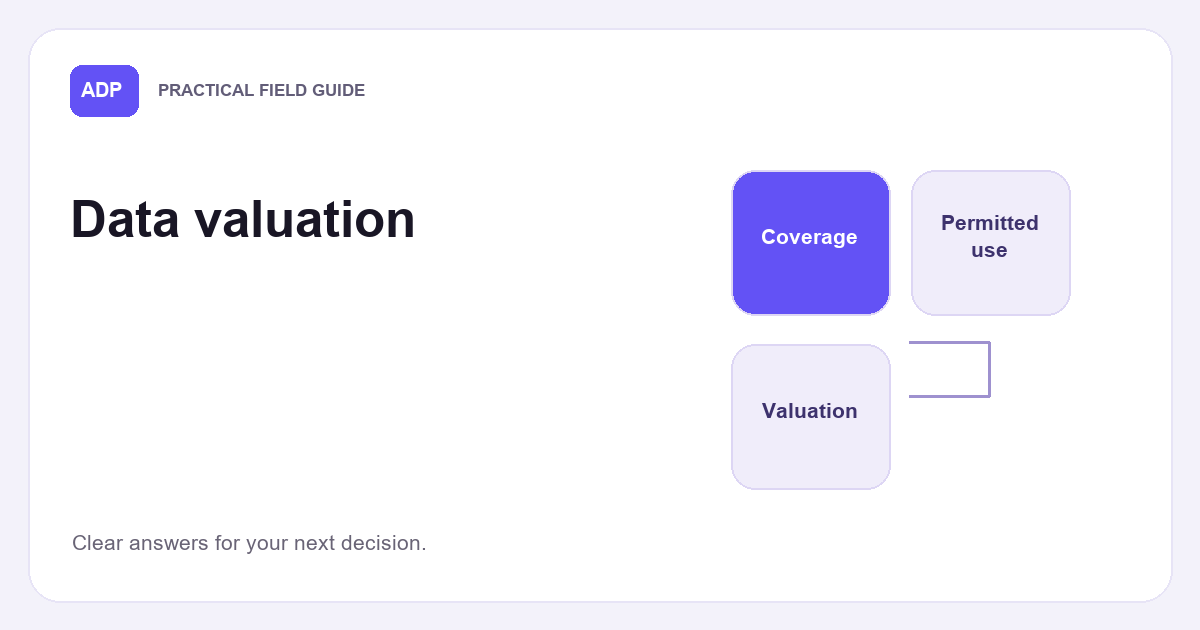
Data valuation can help a company frame a conversation about defined operating records. It cannot determine what an unknown buyer will pay. Start with a specific collection, a proposed use and dated assumptions. The result is a discussion worksheet that can change when its inputs change, not a formal valuation or an offer.
The equipment-maintenance archive below is entirely hypothetical. Every pound figure is an invented worksheet input, not a typical charge, quote or evidence of demand. ADP makes independent introductions and never handles datasets. A buyer and an owner would agree any licence themselves.
Which records belong in the exercise?
Begin data valuation with a collection that can be described and counted, rather than the whole company database. For the hypothetical archive, define fault reports, attempted repairs and recorded outcomes from one maintenance system. Note the years, source system, approximate number of entries and exclusions. If the proposed collection changes, revisit the calculation.
Check record coverage by field as well as by date. Ten years of historical records might contain only three years with repair outcomes. Note when fields were introduced, whether older files remain readable and whether changes in fault codes affect comparisons. A long time span alone does not establish that the collection suits a particular use.
State the proposed use, such as a one-off licence for specified development work. Check questions about data rights, contractual restrictions, third-party material, confidentiality and information about individuals separately. Holding a report does not settle what may be included in a licence. List unresolved questions rather than silently including restricted material.
What would preparation cost the owner?
The owner’s side of data valuation starts with the work required to deliver the defined collection. Ask the people involved to estimate extraction, field mapping, data quality checks, review of restrictions and support after delivery. Record who supplied each estimate and what it covers. Otherwise, a low figure may simply omit work that still has to be done.
For this hypothetical archive, assume £6,000 for extraction, mapping and checks, plus £2,000 for an independent review of restrictions and handling questions. Allow £2,000 for answering field questions and correcting agreed delivery errors. The total is £6,000 + £2,000 + £2,000 = £10,000. These are assumptions, not observed costs.
If the owner requires its stated preparation costs to be covered, £10,000 becomes its initial lower bound for this exercise. It is not an automatic asking price. The owner might require more to justify disruption, while a narrower collection might cost less to prepare. Change the bound when the underlying work changes.
What could a buyer use instead?
Buyer-side data valuation asks what buyer alternatives could serve the same task. These might include public material, new observations, another licensed collection or a smaller project. A data marketplace overview can help frame a search, but finding a listing would not establish that its records contain comparable fault-to-repair outcomes.
For the hypothetical worksheet, assume assembling a substitute with comparable outcomes would cost £17,000 and adapting its categories would cost £3,000. The assumed replacement cost for the task is therefore £17,000 + £3,000 = £20,000. Neither component is a market quote, a stated buyer budget or a prediction of what anyone would pay this owner.
Describe the substitute beside the numbers. Does it include attempted fixes, confirmed results and comparable dates? Could a cheaper source answer the intended question well enough? The £20,000 benchmark is useful only while the assumed alternative is plausible. Money a buyer might spend elsewhere is not necessarily money it would offer for this archive.
Which details could change the comparison?
A data asset valuation worksheet adds a useful check to data valuation by distinguishing relevant detail from sheer volume. In this hypothetical archive, a sequence linking a fault, an attempted fix and its outcome might be more relevant to a particular task than many isolated fault labels. That is something to investigate, not a claim about an unknown buyer’s requirements.
Count complete sequences and inspect an appropriately controlled sample for duplicate jobs, inconsistent codes and missing outcomes. If early entries contain descriptions but no results, report those years separately. Removing incomplete entries could improve consistency but leave fewer comparable cases. Revise the collection and both cost assumptions if this check changes the proposed scope.
Check whether useful fields can be included under the proposed arrangement. Manufacturer diagrams, confidential customer details and information about individuals raise different questions. The ICO’s introduction to anonymisation explains why removing obvious identifiers is not necessarily enough to make information anonymous. Keep fields requiring further checks outside the assumed deliverable until their status is clear.
Does the proposed licence include updates?
Separate a fixed archive from future deliveries in data valuation. A collection with an end date has preparation work that can be estimated now. Quarterly updates would bring new extraction, checks and support. Add refresh costs only after describing what would be delivered, how often it would be delivered and the work each delivery requires.
Write down the licensing terms used in the worksheet, including proposed use, duration and whether delivery happens once or repeatedly. An exclusive licence might limit the owner’s other options, so the one-off cost-based bound should not simply be reused for it. The licensing agreement guide offers questions for a separate discussion.
If updates are uncertain, calculate the fixed archive first and leave future deliveries out of its figures. Do the same for other uncosted commitments. ADP can use a scoped description when making an independent introduction without receiving the records. The description should make clear which proposed deliveries the current figures cover.
How do the conditional bounds fit together?
Among data valuation methods, this worksheet compares the owner’s chosen minimum with the cost of a plausible buyer substitute. On the hypothetical inputs, the minimum is £10,000 if the owner requires its preparation costs covered. The substitute and adaptation total £20,000. That gives a conditional valuation range of £10,000 to £20,000 for the stated one-off collection and use.
If you are considering how to price data, label each boundary before using data valuation in a conversation. The lower figure reflects an assumed owner requirement, not a rule that preparation costs determine price. The upper figure is an assumed alternative cost, not a known buyer limit. An interval between them is neither a formal valuation nor an offer.
Keep an assumptions table beside the arithmetic. Include the collection and exclusions, proposed use, each owner cost, any additional owner requirement, the substitute and its adaptation cost. Mark the £17,000 substitute estimate as unverified. Someone reading the table should be able to change an input and see which boundary moves.
What if the bounds do not overlap?
Stress-test the data valuation worksheet with a second hypothetical case. Suppose a comparable substitute costs £6,000 to assemble and £3,000 to adapt. Its assumed total is £9,000. Against the unchanged £10,000 owner minimum, the bounds do not overlap. There is no £10,000-to-£9,000 interval to discuss under those assumptions.
That result does not answer how much is data worth to every possible buyer. It says this combination of owner requirement and assumed substitute cost leaves no shared interval. Check whether the substitute really is comparable and whether every owner cost applies. Do not remove necessary work from the calculation merely to make the figures overlap.
A narrower collection could cost less to prepare, but it could also be easier to replace. Recalculate both boundaries if scope changes. Alternatively, leave the worksheet unresolved until better information is available. Even an overlapping interval would not establish that an unknown buyer has a project, a budget or an interest in these records.
What should the company check next?
Prepare for a possible buyer review by testing the assumptions most likely to move the boundaries. Here, the £17,000 substitute estimate has no buyer confirmation, and the number of complete repair outcomes needs checking. For broader context, MIT CISR’s research on data monetisation and the data monetisation guide do not establish a price for this archive.
Prepare a short description of the business records, relevant dates, counts of complete outcomes, known exclusions and estimated internal work. Owners exploring whether to sell your company data can use that description to frame a conversation without sending raw records to an introducer. Keep unresolved permission and handling questions visible.
If you are asking how to value data at this stage, use the completed data valuation worksheet to decide which assumption to test next, not as a formal valuation. If the collection cannot yet be defined, postpone the range. If an ADP introduction leads to discussion, the buyer and owner agree any licence between themselves.
Frequently asked questions
Is the discussion range a price I should quote?
No. It compares a stated owner minimum with an assumed substitute cost for a defined collection and use. It is neither a formal valuation nor an offer. Revise the worksheet when the scope, costs or evidence about alternatives changes.