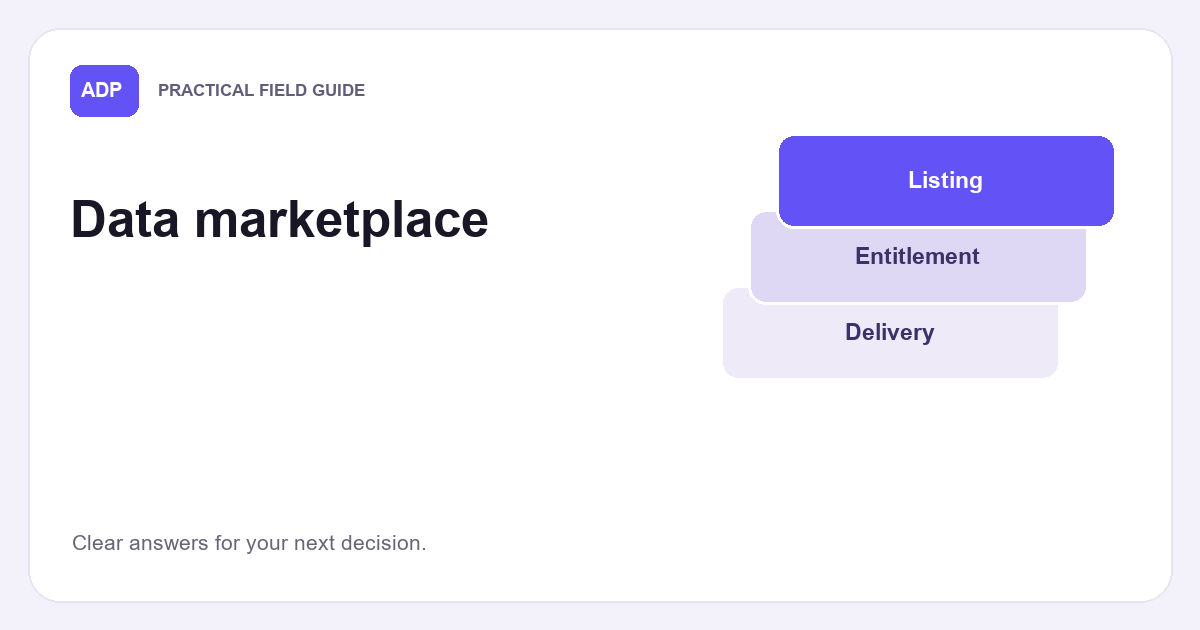
The question 'what is a data marketplace?' often brings to mind a searchable catalogue and a download button. For an owner, the demanding work is defining an extract, checking what may be disclosed and delivering what its description promises. A weekly feed adds a recurring obligation that a fixed historical file does not.
Across data marketplaces, being discoverable does not remove the need to check fields, assess requests or maintain releases. A data marketplace description should reflect an export your team can reproduce and explain, including missing weeks. ADP can make independent introductions, but the owner decides what to prepare and whether to release it.
Define the product before listing it
A data marketplace offer should specify a repeatable unit of delivery, not suggest access to an entire system. In a hypothetical wholesaler's stock extract, one row might represent one product at one depot on one observation date. State whether an absent row means no observation rather than assuming it means zero stock.
Create a data dictionary that defines each field, its units, permitted blanks and identifiers. Include the time zone, source cut-off and meaning of a stock figure. Ask an operations colleague to compare those definitions with an actual export, then ask whoever produces the file whether the same selection can be made again.
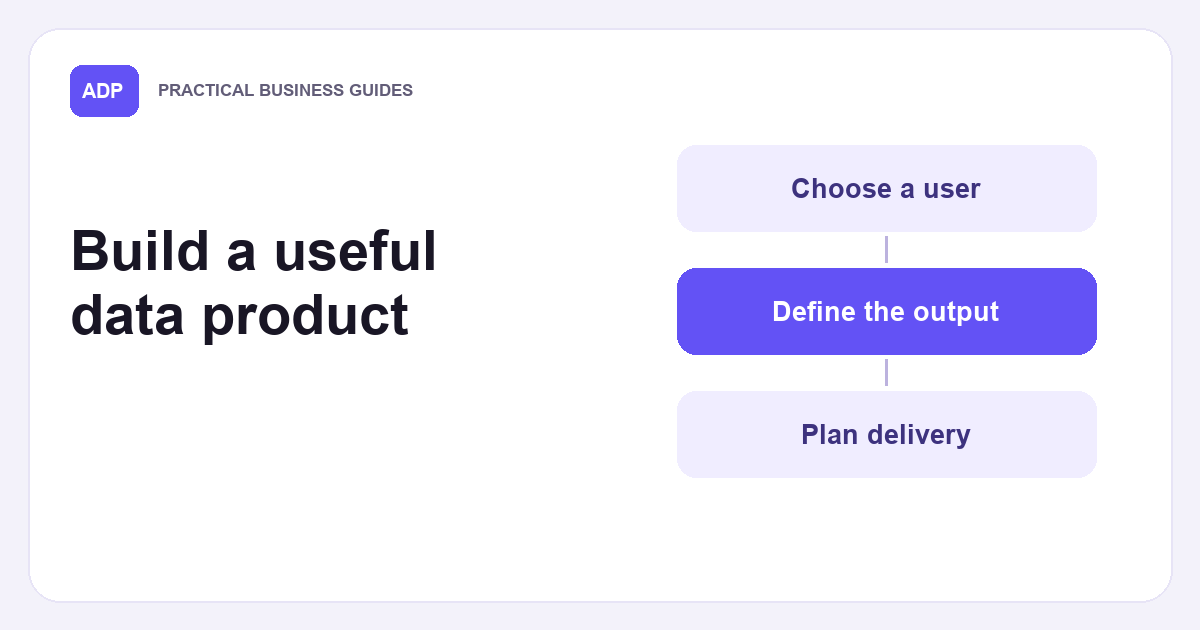
Set boundaries around historic records, locations and source systems. If a depot joined later, describe its shorter coverage rather than implying a complete history. Clear specifications make data products easier to check when codes change or weeks are missing. See how to design a data product for related preparation questions.
Write claims you can check
For data marketplace examples, consider the hypothetical stock extract rather than claiming it suits every analysis. Its listing requirements might state the fields, covered depots, earliest available date, update frequency and known gaps. Ask someone familiar with the source to test each statement against a real export before the description goes live.
If you hope to sell datasets, explain coverage without exposing confidential detail. Even sample data can reveal a customer relationship when narrow dates, products and locations appear together. A schema and broad counts may answer initial questions. If you use invented example rows, label them as hypothetical rather than presenting them as observed records.
A data marketplace description does not authorise distribution. Check who can approve release and whether confidentiality restrictions, personal information or third-party material appear in the proposed extract. Keep access permissions for real files separate from permission to read a public description. Hold sensitive field detail back until an authorised enquiry has been reviewed.
Choose how people discover the offer
Data marketplace platforms have different provider workflows, so inspect current controls before choosing one. The AWS Data Exchange provider guide illustrates preparing data sets and revisions for distribution. AWS is only an example of a marketplace workflow here. Check how a proposed description, release and subsequent correction would work in the chosen setting.
Some data marketplaces can show a public description while details are discussed privately. Decide what an unknown visitor could infer from categories, dates and locations. Discovery settings and usage rights answer different questions. The owner and buyer still need to agree what a recipient may do with any material that is eventually supplied.
Before posting on a data marketplace, walk through the path from finding the description to requesting access. Assign someone to receive enquiries, update wording and remove an outdated offer. Read the provider's current contract terms rather than assuming an interface settles approval decisions, delivery obligations or the terms the owner and buyer will agree.
Review requests before releasing records
For an approval team, the question 'what is a data marketplace?' begins with who can authorise a release, not with a search page. Check who is asking, which fields they seek and what proposed use is being discussed. A direct licence negotiated without a public listing raises the same questions before any file leaves the owner.
A data marketplace request button should lead to a recorded decision, not an automatic transfer. If you sell data sets, identify who can decline a request, narrow the fields or ask for more information. Record the recipient and approved version so a later correction can reach the people who received that particular release.
A schema or clearly invented rows may answer format questions before a real extract is considered. Check actual extracts for indirect identification. The ICO introduction to anonymisation explains why removing direct identifiers alone may not make information anonymous. Keep review files in the owner's controlled process, not with ADP.
Set up a delivery method your team can run
Choose a delivery method your team can operate and revoke. Dated files may suit snapshots if each release is checked and recipients can identify its edition. Document the refresh schedule with a source cut-off, publication time and responsible checker. An API may support frequent updates, but it also requires authentication and monitoring.
Estimate support costs in working time as well as any delivery charges. Someone must explain fields, update contacts and investigate discrepancies. Test a complete export through the proposed channel, including how to send a replacement, before promising a continuing service. Data monetisation provides broader context, but the delivery routine must work on its own.
A data marketplace may provide delivery tools, but it cannot reconcile the owner's source figures. Keep a local record of each export, its checks, approval and recipients. If a depot is omitted, decide whether to hold the release or issue a clearly labelled partial file, but only if the agreed delivery process allows one.
Work through one weekly release
In a hypothetical weekly feed, a wholesaler tracks 600 products at each of three depots and includes one row for every product and depot in a complete snapshot. That is 600 × 3 = 1,800 rows each week. Four complete snapshots contain 4 × 1,800 = 7,200 rows. These figures describe file volume, not demand or earnings.
Each week, a colleague would extract records, check expected product and depot combinations, compare figures with the source, approve the file and publish a dated edition. If you sell data sets on this basis, name a deputy for the checker. Missing combinations must be investigated rather than silently converted to invented zeros.
Suppose one depot misses its reconciliation cut-off in that hypothetical feed. The owner could hold the release or, if the agreed process allows it, issue an explicitly incomplete edition. Record the gap and tell recipients what changed, which dates are affected and whether a replacement is planned. This takes time even when extraction is quick.
Maintain the feed after publication
Keep a version log with observation date, release date, source cut-off, checks and corrections. If a backdated transaction changes an earlier snapshot, decide whether to restate that edition or show the adjustment later. Tell recipients exactly which file replaces which, so they can trace the editions used in their own work.
Update a data marketplace listing when fields, depot coverage or publication timing change. Notify existing recipients as well as future visitors. Before adding a column, review whether it changes what can be inferred from the extract. Retain the previous specification so recipients can understand differences between editions and amend their own import process.
Review missed deadlines and manual repairs over several cycles. If production repeatedly depends on exceptional effort, narrow the scope or reduce the promised frequency before offering the feed more widely. Give recipients a route to report discrepancies and identify who responds. Maintenance then becomes an assigned task rather than an open-ended promise.
Compare a weekly feed with a historical licence
If you intend to sell your company data as a fixed historical extract, define the dates and fields, check the file and agree how to deliver or correct it. There is no recurring feed unless the owner and buyer include one in their agreement. A weekly service needs checks and contacts for each subsequent release.
Compare one-off preparation with the time needed for continuing releases. A data marketplace listing cannot show whether anyone wants the extract or what buyer and owner might agree. Questions about assessing an offer can help frame that comparison. Choose the weekly route only if the team can sustain its stated scope and timing.
If a conversation is more suitable than a listing, you can sell your company data by discussing a defined extract first. ADP makes independent introductions and never handles datasets. The owner and buyer agree the licence themselves, including the material to be supplied, the delivery method and whether future updates are included.
Frequently asked questions
Can a historical file be listed without weekly updates?
Yes. Describe it as a fixed, dated extract with stated coverage, rather than suggesting live access or repeat releases. The owner and buyer can agree its delivery scope and any correction process in their licence.