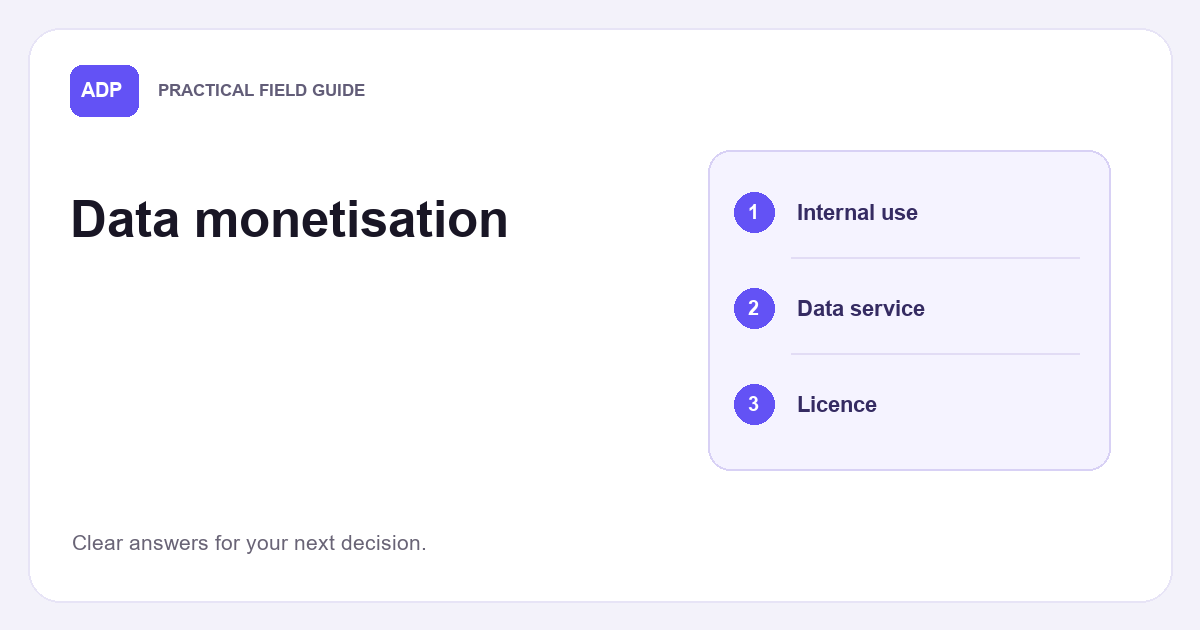
If you are asking what is data monetization, the useful answer is not necessarily selling information. It can mean reducing a cost, creating a service or exploring a licence. This guide treats data monetisation as a first-year investment decision, with a separate test for each route rather than an assumed return.
Imagine a hypothetical appliance-repair company completing 600 jobs a year. Its operational records contain fault descriptions, parts fitted, technician notes and return visits. The company could use them to improve repairs, offer customers a report or investigate outside interest. Every price, cost and result below is an illustrative assumption, not an observed outcome or market rate.
Choose the decision before the number
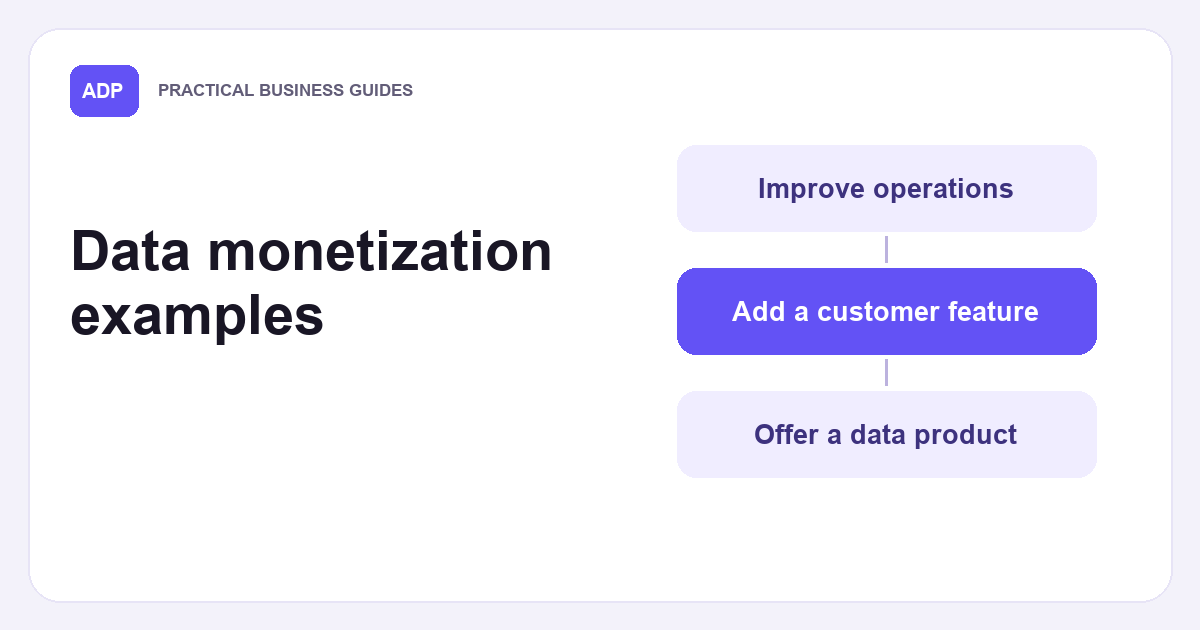
Three data monetization models answer different questions. Can the company avoid wasted trips? Will customers pay for a useful account of their repairs? Might a suitable buyer request records under agreed terms? If you are deciding how to monetize data, name the decision first. MIT CISR's research provides wider context on the economic impact of data initiatives.
A data monetization strategy needs comparable first-year costs, including staff time already on the payroll. The service manager might spend a day checking repeat visits, drafting a report or describing the archive. Count that time in each route and note the work it displaces. An enquiry is not a receipt, and a freed hour is not automatically a saving.
Use a simple data monetization framework with four entries for each option: the proposed change, the spending it requires, the event that produces a return and the evidence needed to proceed. This keeps monetizing data grounded in a test. Do not combine a possible licence payment with booked customer revenue or count capacity as income before it can be used.
Test the internal saving
One of the practical data monetization examples is a better pre-visit checklist. The firm could review completed jobs to see whether missing fault details led to second trips, then ask technicians to record the information needed to bring the right parts. A pilot should measure extra recording time as well as return visits, using complete jobs rather than a single faster stage.
Suppose the return-visit rate falls from 8% to 5% across 600 annual jobs. That means 48 visits before the change and 30 after it, or 18 avoided trips. At 90 technician minutes each, 18 trips release 27 hours. Assume £500 for set-up and £240 for upkeep. The rate change remains a hypothesis until the firm tests it.
If those 27 hours can be filled with work contributing £40 an hour after direct costs, they contribute £1,080. At £10 of separate travel or parts costs avoided per trip, another £180 is saved. Subtracting £740 of project costs leaves a hypothetical £520 first-year benefit. Without replacement work, the result is £180 minus £740, a £560 cost. Test whether the diary can use the released time.
Check demand for a customer report
A paid report is a different choice among data monetization models. This hypothetical offer would summarise a customer's recorded repairs and suggest questions for the next service, without claiming to diagnose a fault or supply a complete appliance history. The firm would need a clear template, a way to check incomplete entries and someone to answer questions. See the guide to data products for product-planning context.
Assume one annual report costs £60 and 40 customers order one in the first year. Revenue is 40 times £60, or £2,400. If each takes an hour of staff time at £20, labour is £800. Add £350 of set-up work and £250 of annual administration. The resulting hypothetical contribution is £2,400 minus £1,400, or £1,000.
The data monetization strategy should test the proposed output before budgeting 40 orders. Each report contributes £40 after its £20 labour cost, so 15 paid reports cover the £600 fixed cost and 16 would produce a positive contribution on these assumptions. Ask customers what they would use, then time a sample report. Longer production or weaker demand changes the calculation.
Explore licensing without assuming a sale
A possible licence is one of the external data monetization strategies, but an enquiry cannot be entered as revenue. The sell your company data page describes an introduction route, not a commitment to purchase. The firm can first describe its archive at a high level, including dates, record types and gaps, without preparing or sending a collection.
ADP makes independent introductions and does not handle datasets. Write down buyer requirements before licensing your records: which fields are requested, for what proposed use, in what format and with what coverage. A specific request would let the owner estimate preparation work. It would not, by itself, establish that the proposed disclosure is permitted or that terms will be agreed.
Check the proposed material before any disclosure, especially technician notes or customer details that might identify people. The ICO's introduction to anonymisation helps distinguish anonymisation from simply removing names. The owner must also examine relevant confidentiality commitments and contractual restrictions. An archive description is a sensible first test because it does not require sending the underlying files.
Set a ceiling on the licence trial
For another of these data monetization examples, suppose a buyer might hypothetically pay £3,000 for a suitable collection under an agreed use. Assume £300 to investigate, £700 to prepare material that can be provided and £250 for review and follow-up. The £3,000 is not an offer, and the costs are comparison figures rather than a quotation.
If the parties agreed a licence, the buyer paid £3,000 and all three costs arose, the illustrated net would be £3,000 minus £1,250, or £1,750. If the enquiry ended after the initial investigation, the result would instead be a £300 cost. Spending all £1,250 on an unsuccessful attempt would leave a £1,250 cost. These are distinct outcomes, not interchangeable forecasts.
Apply the data monetization framework by limiting the first investigation to £300 in this example. Consider the further £950 only if a sufficiently specific request makes preparation worth assessing and the owner can establish what may be provided. The data valuation guide offers further questions for comparing an uncertain opportunity, but a possible payment should remain conditional in the budget.
Keep permissions and preparation separate
If the owner asks how to monetise data through an outside use, start by tracing where the business records came from. Job entries, manufacturer material and customer correspondence may carry different restrictions. Map who supplied each category and what existing agreements say about reuse or disclosure. Having a copy of a record does not, on its own, answer those questions.
Data monetization strategies also create different ongoing work. A report needs repeatable customer checks and delivery. A proposed licence may require decisions about permitted use, retention, onward sharing or exclusivity, depending on the terms discussed. Record who would correct errors and whether a commitment would obstruct a future internal use. Do this before treating either route as a finished product.
ADP never handles datasets, so the owner remains responsible for any preparation and proposed disclosure. The buyer and owner agree the licence themselves, including its scope and delivery conditions. The introduction to AI training-data licensing can help frame questions about terms. It does not establish that these repair records suit a particular request.
Compare the choices on one page
For a manager still asking what is data monetization, a one-page comparison makes the answer concrete. Put confirmed spending, avoided costs, staff time and contingent receipts in separate rows. Beside each figure, write what must be true, who will check it and when the firm will stop spending. That prevents the largest conditional number from deciding the case.
On these assumptions, the internal change produces £520 only if released hours can earn the stated contribution. The customer report produces £1,000 only if 40 people pay and delivery takes the planned time. The licence produces £1,750 only if suitable terms are agreed and payment arrives. An investigation that stops early costs £300. None of the three figures is a business forecast.
Compare the manager's available time as well as the totals. If report work displaces profitable repairs, £20 an hour may understate its cost. If technicians have spare capacity, £40 an hour may overstate the internal benefit. Recalculate those assumptions using the work the firm would actually gain or give up, then favour the route with a question it can test cheaply.
Run three small tests with stop points
For the internal route, review a sample of recent return visits and trial a clearer pre-visit checklist. Record the return rate, additional note-taking time and whether freed appointments can be filled. Continue only if the observed change looks capable of covering the £740 annual set-up and upkeep assumption. Otherwise, revise the checklist or stop the trial.
For the report, make one sample from material the firm can use, show its proposed format to customers and ask whether they would pay £60. Time its production rather than assuming an hour. If interest is weak or delivery costs rise, update the 15-report break-even calculation before building a reporting process. A sample tests both usefulness and fulfilment effort.
For licensing, prepare an archive description rather than a dataset and cap the first investigation at the hypothetical £300. Revisit the decision only when a specific request supports a closer check of permissions, preparation and proposed terms. ADP can make an independent introduction without receiving the files. The owner can then choose whether further work merits its time.
Frequently asked questions
Which route should the repair firm test first?
Start with the cheapest question the firm can answer reliably. A short review of repeat visits tests the internal case, a sample report tests customer interest, and an archive description tests whether a licensing enquiry is specific enough to investigate further.