Data monetization examples are most useful when they show what a business makes available, who might use it and how access works. A public description of an API is evidence of a delivery model, not proof that a particular deal generated income. Keeping that distinction in mind makes different approaches easier to compare.
This article looks at Deere’s field operations documentation, Nasdaq’s dataset access and MIT research on internal improvement. It then offers a clearly hypothetical AI licence scenario. ADP makes independent introductions between organisations and potential counterparties, and never handles datasets. The owner and buyer, not ADP, agree any licence.
How to compare public evidence
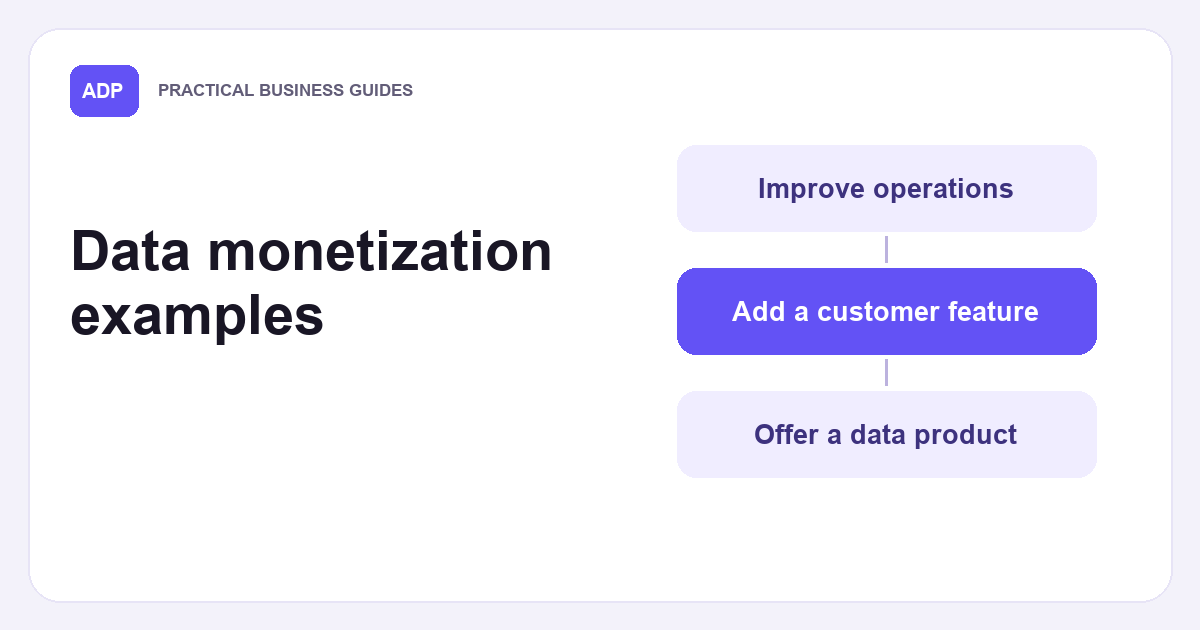
Start by sorting data monetization examples according to the question each one answers. For data monetization use cases, ask whether an organisation improves its own processes, offers information through a product or considers a separate licence. Those routes have different users and delivery requirements, even when the underlying information looks similar.
Public data monetization case studies often tell you what a service exposes but not what it earns. When checking examples in practice, note whether the source describes an endpoint, a subscription or a measurable internal change. If prices, uptake and costs are absent, leave them blank rather than filling the gaps with assumptions.
Read data monetization examples as evidence about design, not as proof of business value. Record the named publisher, the documented access method and what remains undisclosed in three columns. This comparison stops a published technical feature being mistaken for a profitable contract and gives colleagues a useful starting point for further questions.
What Deere’s field operations documentation shows
Deere’s field operations API documentation is a concrete entry among data monetization examples. It documents field operation totals, maps and point data. That shows how operational data can be organised for access through an API. The documentation alone does not establish a particular customer contract, revenue amount or AI use.
The useful lesson is to distinguish an interface from the source records behind it. An API description tells a developer what kinds of information can be requested, not whether every record is complete, current or suitable for reuse. For a similar project, document your data collection process, update intervals and known gaps before designing access.
This is also a way to think about a customer product without assuming Deere’s commercial results. A team could specify which users need summaries and which need map or point detail, then decide how product access should work. The public documentation illustrates the structure of an offering, not its commercial performance.
What Nasdaq’s access model shows
Nasdaq’s Data Link description provides another of the data monetization examples. It describes API datasets and a real-time index feed, showing a route for distributing financial data through defined technical access. That is a product description, not a disclosed account of revenue from a particular dataset or client.
Where the Deere documentation points to different levels of field detail, Nasdaq illustrates a different delivery question. If users need timely information, data feeds introduce decisions about update frequency, identifiers and how changes are communicated. Assess those requirements against the intended user’s task rather than assuming an API alone makes information useful.
Do not confuse a live feed with historic data, which may require different coverage, timestamps and documentation. Before offering either, specify what a user would receive and what ongoing support would involve when a format changes or delivery fails. Those are planning questions prompted by the public description, not claims about Nasdaq’s service commitments.
Why internal improvement belongs in the comparison
The MIT CISR research gives data monetization examples a counterweight by examining internal improvement rather than only outward-facing access. Operational savings can be an objective when better information changes how a business works. Research on an approach, however, should not be read as a calculated saving for your organisation.
This distinction is easily lost when data monetization case studies sit side by side. Internal improvement has a different test from offering access to outsiders. Compare an existing process with a proposed one, note staff time and error rates where measurable, and state what else changed before attributing an observed difference to information alone.
For a broader account of these routes, see the data monetisation guide. For an internal proposal, choose one decision or workflow, write down its present baseline and decide what evidence would show improvement. That makes the project assessable without inventing a sale or licence.
A clearly hypothetical AI licence
As a hypothetical entry among data monetization examples, consider a manufacturer exploring AI licensing. It could prepare a documented extract of past machine maintenance events for a possible AI developer. In this fictional scenario, the developer might request consistent fault categories and dates to test a model. This is not a reported transaction.
The parties would first identify which licensed records could be included, what permissions and restrictions apply, and whether sensitive fields should be removed. They would then agree buyer rights in the licence, including permitted purpose, duration, access method and whether later updates are included. This is a checklist for the hypothetical scenario, not a statement about anyone’s actual rights.
The scenario is useful because a technical file and a licence answer different questions. The file describes fields, formats and coverage. The agreement would set permitted use and responsibilities, with the owner and buyer agreeing its terms directly. Nothing in the Deere, Nasdaq or MIT sources identifies this fictional dataset or its prospective user.
How to prepare a dataset description
To adapt data monetization examples to your own organisation, begin with one bounded dataset and one user need. Write a short inventory of fields, time span, update frequency and missing entries, then list where each item originates. This is more useful than declaring every spreadsheet a potential offering because it exposes work needed before an outside discussion.
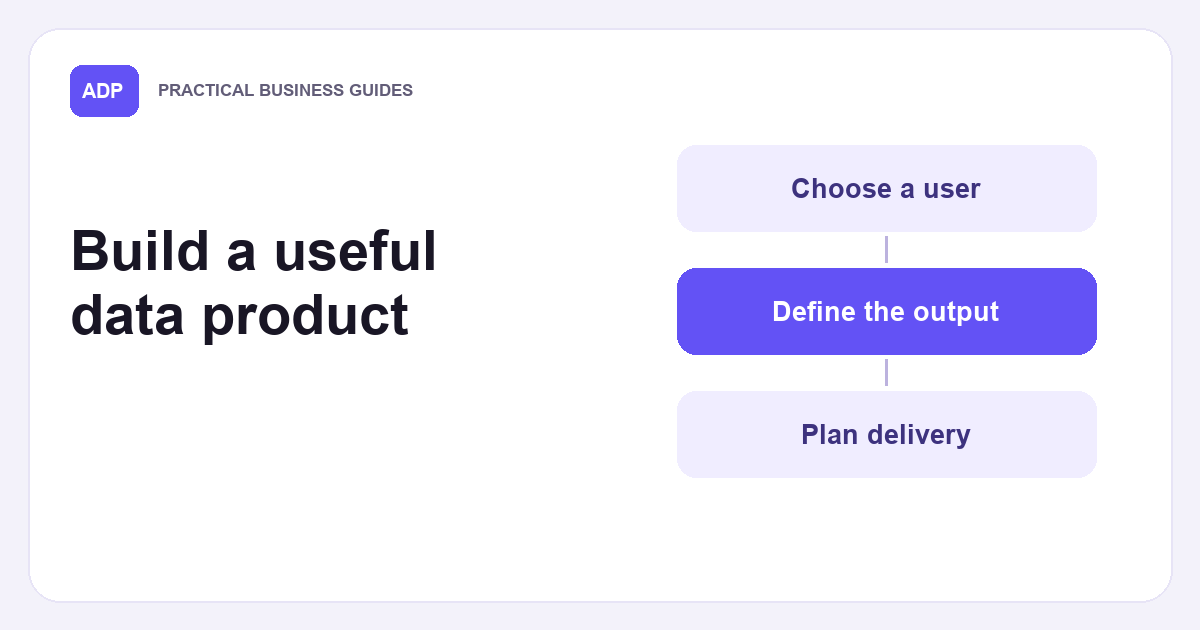
A guide to data products can help frame that inventory as a specification. Describe the output a recipient would receive, its format, documentation and a contact for questions. Keep internal reports separate from files intended for external use, and mark unresolved provenance or confidentiality questions for the relevant people to assess.
If you are exploring whether to sell your company data, prepare a short, non-sensitive description rather than uploading raw material to an introduction service. State the proposed use, available history and expected updates. A clear summary lets a potential counterparty ask informed questions while the underlying dataset remains with its owner.
How to approach an introduction
Data monetization examples can clarify what to ask a prospective counterparty before discussing access. ADP makes independent introductions, but it does not receive, store or handle datasets. Start with a non-sensitive description of coverage and intended use, then let the owner and interested buyer decide what information they need to evaluate a possible licence.
The guide to selling AI data offers further questions for a prospective AI use. In an initial conversation, check whether the proposed task calls for snapshots or updates, what documentation would be useful and who would review restrictions. Avoid sharing underlying files simply to test interest or assuming an introduction implies acceptance.
If discussions continue, the owner and buyer can agree the licence themselves. Its scope may need to address permitted use, delivery, security expectations, changes and termination. Record unresolved questions rather than presenting standard terms as universal. A carefully described dataset can support a discussion, but its suitability depends on the parties’ specific requirements.
How to put the comparison to work
The practical conclusion from data monetization examples is to separate public evidence from a proposed deal. Deere documents levels of field operation information. Nasdaq describes API datasets and a real-time index feed. MIT’s work helps frame internal improvement. None of these public descriptions supplies case revenue figures for the examples examined here or establishes an AI licence.
Choose a route before preparing a proposal. For internal work, select a workflow and baseline. For an external offering, specify users, fields and delivery. For a hypothetical licence, identify the intended use and questions that require agreement. That sequence keeps technical capability, commercial assumptions and permissions in their proper places.
Use a one-page brief with the source of the information, documented coverage, proposed format and open questions. ADP can make an independent introduction using a non-sensitive description, without handling the dataset. The owner and buyer would decide whether to proceed and agree any licence directly, rather than relying on an example as proof of demand.
Frequently asked questions
Do Deere or Nasdaq disclose revenue from these examples?
The cited pages document access and product features, not case-specific revenue figures. They do not establish a relationship with ADP or identify an AI data buyer. Use them to understand technical packaging, not to estimate proceeds from a comparable project.
Is internal improvement the same as licensing data?
No. Internal improvement concerns an organisation’s own work, while a licence would define a third party’s permitted use. The AI scenario above is hypothetical, not a reported deal. For either route, start by specifying the intended task and what evidence would help assess it.